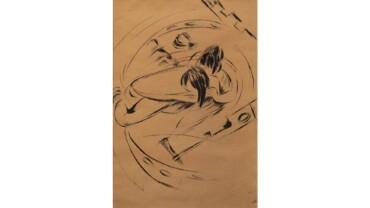

Fanesi Bruno ( born in Ancona, 1915-2012) was an Italian artist. He studied at vocational schools in Ancona. From 1952, beginning with his solo exhibition at the Galleria Puccini in Ancona, he started participating in major regional and national art exhibitions, where he received numerous awards and distinctions. He held solo exhibitions in all the major Italian cities — in Milan, for example, at the Galleria Bergamini in 1968 and 1971 — as well as abroad, particularly in Yugoslavia, Greece, Israel, Germany, and Sweden.
In 1980, a tribute exhibition was dedicated to him at the Castello di Falconara Alta. In 1986, he was awarded the “Ginestra d’Oro del Conero” in recognition of his artistic merits. From the outset, the artist was close to realist stylistic and thematic approaches; in 1955 he formed friendships with Zigaina and Tettamanti, with whom he shared artistic concerns and social commitment. In 1968, he moved to Milan, where he lived until 1985, when he decided to return to live and work in his native city.
In the years immediately following the Second World War, he devoted himself to a form of painting that bore witness to the many hardships and daily struggles experienced by ordinary people during the period of reconstruction. Around 1960, he worked with forms of neo-Cubist origin; from the mid-1960s, naturalistic elements entered his works. From around 1970 onward, he turned to the motif of the flight of the seagull, a supreme symbol of freedom. He later engaged with the genre of landscape, in which nature is treated in spatial and luministic terms.